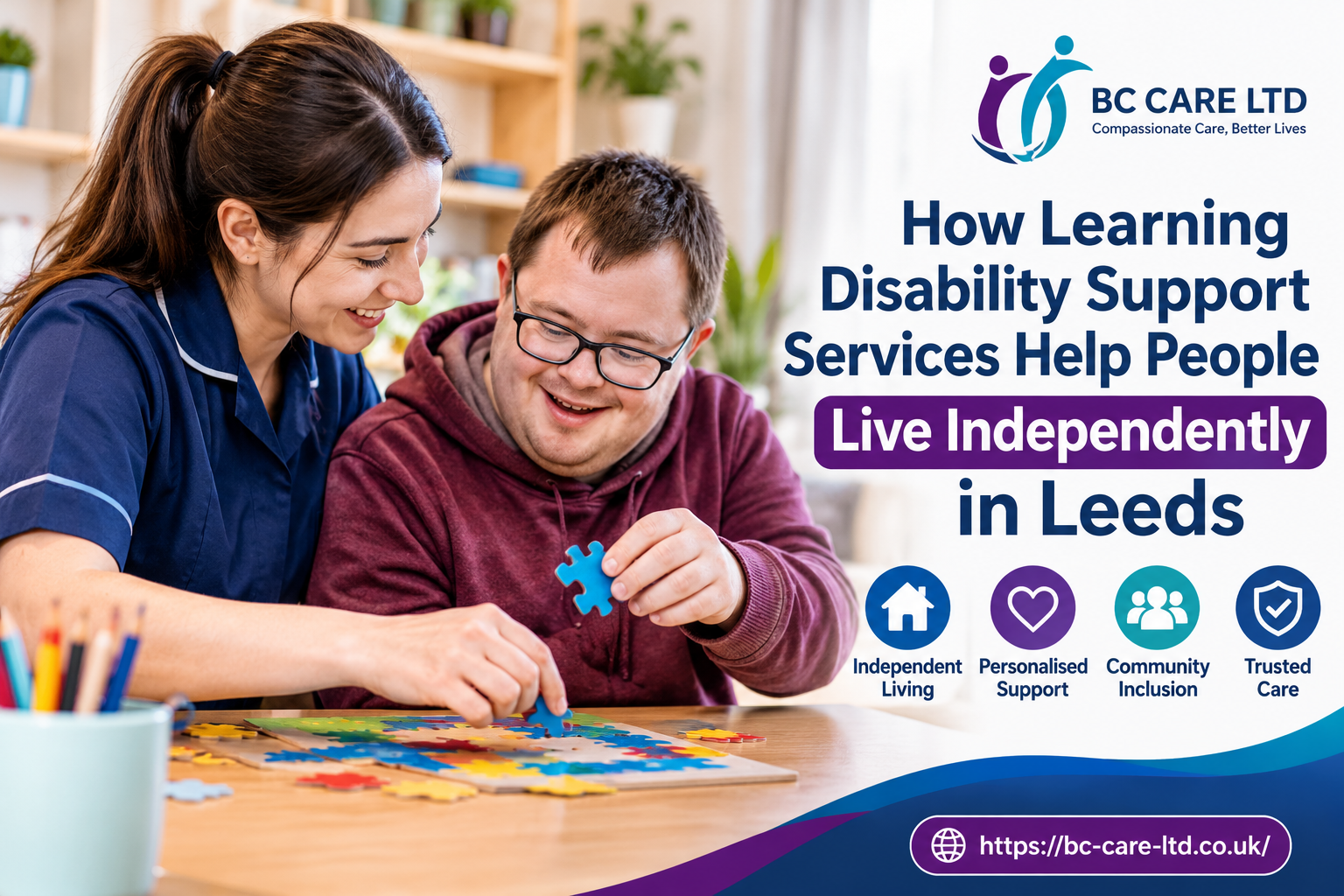
Learning Disability Support Services Leeds: How They Help People Live Independently
Learning disability support services Leeds adults can use help people build skills, make their own choices and live as independently as they can, at home and in the community. Good support does not do everything for a person. It works alongside them, so they stay in control of their own life.
This guide explains what learning disability support services Leeds providers offer, how support works at home and in the community, how the options compare and how to choose a provider. It is written for adults, families and carers in Leeds, and it explains which services BC CARE LTD provides, based on its website.
Understanding Learning Disability
A learning disability affects how a person learns new things, understands information and communicates, and it lasts for life. It ranges from mild to profound, so support is never one size fits all. That is why learning disability support services Leeds wide must be personalised. Autism is different. Many autistic people do not have a learning disability, although some do. The words people use about themselves vary, so always follow the person’s own lead.
What Do Learning Disability Support Services Leeds Offer?
Learning disability support services Leeds wide are described in different ways by different providers, but they usually include:
- Learning disability care at home: visits to the person’s own home for personal care support, daily routine assistance and household tasks assistance.
- Supported living for adults with learning disabilities: the person has their own tenancy or home and receives support, with housing and support arranged separately.
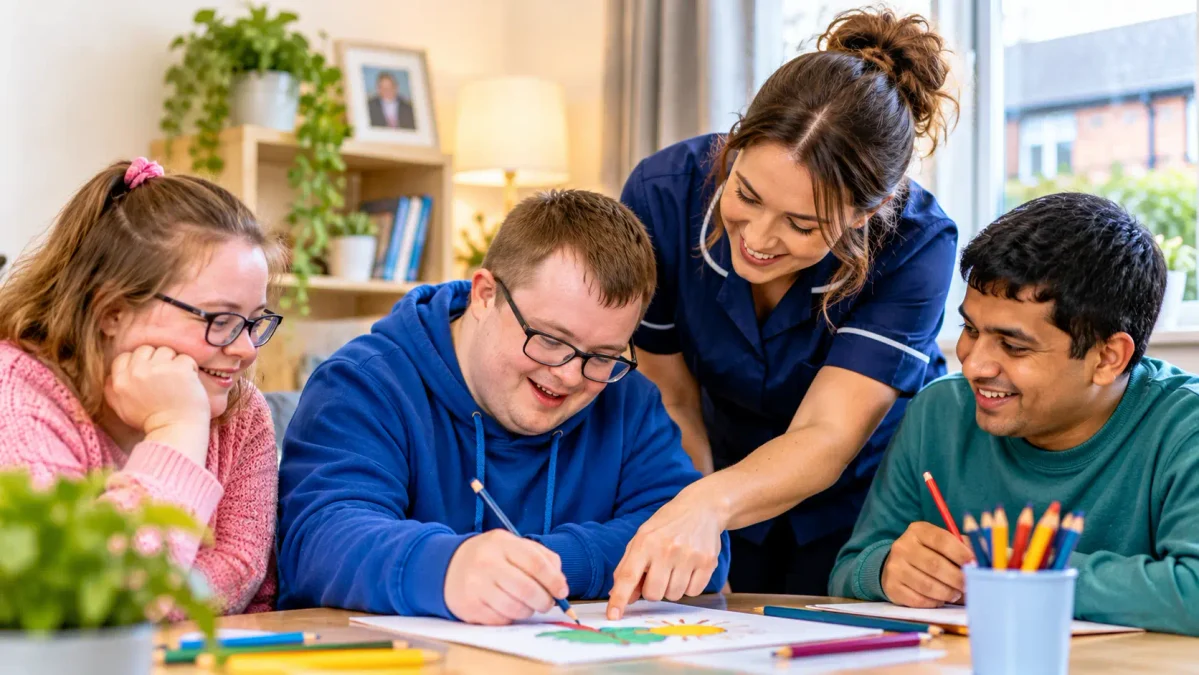
- Community support for learning disabilities: help to go to groups, college, work or volunteering, and to travel safely.
- Specialist learning disability support: specialist care workers who support people with complex needs or health conditions.
- Family support: information, planning and breaks for relatives.
Learning disability support for adults works best when it is personalised. Personalised learning disability care starts with what the person wants, not with what a provider happens to have available. Learning disability care Leeds families arrange can combine several of these at once, and learning disability services Leeds providers describe in different ways may overlap.

Daily Living Skills and Life Skills Development
Daily living skills include cooking, cleaning, budgeting, shopping and using public transport. Life skills development means teaching and practising these step by step, so the person can do more for themselves over time. A good support worker prompts and guides rather than taking over. This kind of supported independence often matters more than any single task. Independent living support Leeds households arrange should have clear goals that the person has chosen.
Communication Support
Communication support might mean Easy Read information, pictures, simple language, visual timetables or extra time to respond. It helps people understand what is on offer and say what they want. Support workers who know someone well learn how they show choices, feelings and discomfort. Learning disability support services Leeds providers run should explain how they adapt communication for each person.
Choice and Control
Choice and control sit at the heart of good support. Under the Mental Capacity Act 2005, every adult is presumed able to make their own decisions unless shown otherwise, and people must be supported to decide. Best interests decisions apply only where someone lacks capacity for a specific decision. Person centred care planning and individual care plans should record routines, goals, likes and what helps when the person is anxious, written with the person and, if they wish, their family.
Confidence Building and Emotional Wellbeing
Confidence building comes from success. Small wins, such as a first bus journey alone, add up. Emotional wellbeing also depends on relationships, so support should include time to talk and to feel listened to. Learning disability support services Leeds adults rely on should notice changes in mood and respond calmly.
Community Based Support and Social Inclusion
Community based support helps people take part in everyday life. Social activities such as clubs, cafés, sports, music and volunteering reduce isolation. Inclusive community activities, in libraries, parks, local groups and colleges, build friendships and a sense of belonging. The best learning disability support services Leeds has to offer treat community life as part of the plan, not a bonus.

Support at Home, Supported Living and Other Options Compared
Adults with learning disabilities Leeds families support have several options. The table compares them in general terms. Details vary by provider and person.
| Feature | Support at home | Supported living | Residential care home | Family support only |
| Where the person lives | Their own home or family home | Their own tenancy or home | A care home | Usually the family home |
| How support is arranged | Visits or planned hours from a provider | Support arranged separately from housing | Accommodation and care provided together | Depends on relatives |
| Independence | Often high, with visits as needed | High, with support built around the person | Can be lower, depending on the home | Depends on the household |
| Best suited to | People who want to stay in their own home | People who want their own tenancy with support | People with higher needs that cannot be met elsewhere | Lower needs, or alongside paid support |
| Flexibility | Hours can usually be adjusted | Support reviewed as needs change | Less flexible, as a move is involved | Flexible but depends on availability |
The key difference is where the person lives and how support is organised. Support at home suits people who already have a home they want to stay in. Supported living suits people who want their own tenancy with support built around them. Residential care provides accommodation and care together and may suit people with higher needs, but it can limit independence. Choosing between learning disability support services Leeds offers depends on the person’s wishes, safety and goals, and arrangements can change over time.
Learning Disability Care at Home and Supported Living With BC CARE LTD
BC CARE LTD is based at Unit 2.1, Oaktree House, 408 Oakwood Lane, Leeds LS8 3LG, with a Bradford location at Suite 28, 62 Tong Street, BD4 9LX. Its website lists:
- Domiciliary care: personalised care and support that helps people live independently at home.
- Personal care.
- Supported living: practical, emotional and healthcare support that promotes independence and wellbeing.
- Specialised care for dementia, mental health and complex medical conditions.
- Consultation and coordination: care planning, assessments and coordination of services across providers.
- Rehabilitation services: physical, occupational and speech therapy aimed at helping people recover and regain independence.
- Care homes.
The website does not specifically describe learning disability services, so families asking about learning disability support services Leeds can ask BC CARE LTD directly what experience and training its team has and how support would be planned. Call 0113 824 1978 or email contact@bc-care-ltd.co.uk.
How to Access Learning Disability Support Services Leeds Residents Need
Start with a care needs assessment from Leeds City Council adult social care. Under the Care Act 2014, councils must assess adults who appear to need care and support, whatever their finances. The assessment looks at needs, outcomes and wellbeing. If the person is eligible, the council agrees a personal budget, and you may be able to take direct payments and arrange support yourself. Some people also have NHS support, and many families arrange support privately. Benefits such as Personal Independence Payment may be available for working age adults, so check GOV.UK for eligibility.
Ask the council about learning disability support services Leeds wide at any stage, even if you are not sure what you need. BC CARE LTD provides consultation and coordination, covering care planning, assessments and coordination of services across providers.
Choosing Learning Disability Support Providers Leeds
Whichever learning disability support services Leeds provider you consider, ask these questions:
- Is the provider registered with the CQC? Providers of regulated care in England must be registered. Read the latest inspection report, and ask every provider, BC CARE LTD included, for its registration details.
- What training do support workers have? Ask about learning disability awareness, communication and positive approaches to behaviour that challenges.
- How is support planned? The person should help write the plan, and ideally meet support workers first.
- How consistent are the support workers? Ask who covers leave and sickness.
- How does the provider work with others? Ask about links with the GP, the community learning disability team and therapists.
- How are safeguarding concerns handled?
- How are families kept informed? Ask how often the plan is reviewed and how progress is recorded.
- How does the provider track goals? Ask how a learning disability support services Leeds provider records progress towards what the person wants.
Common Mistakes to Avoid
- Deciding for the person instead of with them.
- Choosing learning disability support services Leeds providers on convenience or price alone.
- Treating a learning disability as the same thing as autism or mental illness.
- Doing tasks for the person that they could learn.
- Not recording communication needs, preferences and goals.
- Assuming every provider of learning disability support services Leeds wide has the same experience.
- Waiting for a crisis before arranging support.
Frequently Asked Questions
What do learning disability support services Leeds providers do?
They help adults with learning disabilities with daily living skills, personal care, communication, community life and planning, so they can live as independently as possible.
Who can use learning disability support services Leeds offers?
Adults with a learning disability who need support. An assessment from Leeds City Council can help work out what is needed, and families can also arrange support privately.
What is the difference between supported living and residential care?
In supported living, the person has their own tenancy and support is arranged separately. In a care home, accommodation and care come together.
Can someone get support while living in their own home?
Yes. Support can be provided as visits or planned hours at home, and it can be increased or reduced as needs change.
How do families stay involved?
Families can help write the plan, share what they know about routines and communication, and join regular reviews, always with the person’s agreement.
Does BC CARE LTD provide learning disability support?
BC CARE LTD lists supported living, personal care and domiciliary care among its services, but its website does not specifically describe learning disability services. Contact the team to ask what it can offer.
Conclusion
Learning disability support services Leeds adults rely on work best when they put choice and control with the person: building skills, communication, confidence and friendships step by step. Look for personalised plans, trained support workers and regular reviews, and involve the person in every decision.
To talk through options in Leeds or Bradford, call BC CARE LTD on 0113 824 1978 or email contact@bc-care-ltd.co.uk